It’s time to take silence off the shelves.
TOOLS
AfterEffects, Illustrator, InDesign, Photoshop
TIMELINE
8 Weeks,
Fall 2026
PROJECT OVERVIEW
How do you start a conversation about something people are conditioned not to talk about? In collaboration with CMU’s Office for Institutional Equity and Title IX, this project tackled the barriers that prevent students from seeking support after experiencing sexual misconduct.
Through research into self-silencing, stigma, and institutional distrust, I developed a provocative three-pronged awareness campaign that borrows the visual language and gender stereotypes of 1950s advertising, using satire and humor to challenge normalized silence, spark recognition, and make pathways to support feel more approachable.
RESEARCH AND INSIGHTS
The pressure to be agreeable can make seeking support feel like an inconvenience, even when
the experience itself deserves attention.

RESEARCH & INSIGHTS
As I began to dive into the research on barriers to reporting, what I found most compelling was “self-silencing”, a term that kept popping up in all of the research I was finding, a phenomenon specifically found in women and those identifying as women. Self-silencing is the suppression of one's thoughts, feelings, needs, or experiences to avoid anticipated conflict, judgment, rejection, or social repercussions. In the context of sexual assault, it can manifest as withholding disclosure due to internalized shame, stigma, self-blame, or fear of negative reactions.
BIG TAKEAWAYS
Some survivors anticipate that disclosure will place an emotional burden on others, leading them to delay or selectively withhold their experiences, even from people who might otherwise provide support. (Pub Med)
Women may learn to evaluate their own needs through the expectations of others, suppressing their feelings to preserve relationships and avoid conflict. (Jack & Dill (1992))
Anticipating how others might perceive us can shape how we evaluate ourselves, potentially making other people's judgments more salient than our own feelings. (Science Direct)
Together, these findings suggest a potential connection: when someone is accustomed to putting others' comfort first, speaking up about a boundary violation may feel like creating a problem rather than responding to one.
Miss Behave satirizes this conditioning by turning self-silencing into something that can be packaged, advertised, and sold.
artefaCT 01
The Public Service Announcement
Building on Cottonworld’s brief, I set out to craft the visual language for Simply Put. I utilised earthy tones with a single bright accent that stayed true to the existing brand while expanding it for the new campaign. I explored colour, typography, and layout systems across social media and presentation formats to understand how the visuals and imagery could come together in a cohesive, expressive way.
ABOUT


artefaCT 02
On-Campus Provocation
A 2-PRONGED APPROACH THAT LEANS INTO THE EPHEMERA OF THE RETAIL WORLD:
Posters advertising Miss Behave on campus @ Scotty’s Market, with tear off “coupons”
Corresponding bottle neckers on cleaning products @ Scotty’s Market on campus
A series of posters announcing Miss Behave’s arrival at Scotty’s Market, inviting students to tear off double sided coupons that instead “redeem” their voice and agency, with IEX information on the other side.
Rather than creating an entirely new line of home goods, the provocation uses existing cleaning products and their language of “cleaning up” to challenge self-silencing. Each bottle necker corresponds to a specific family/category of cleaning products and integrates IEX information below the catchphrase.
Placed in first year dorms and freshman-centric eating areas (use of meal plan).
Targeting first year students spending flex dollars on their meal plan in Scotty’s


I set up the intervention on Thursday, October 1st. By Wednesday, October 7th, 90% of the coupons were taken.


To assess the effectiveness of both physical interventions, it was important to establish tangible ways of measuring audience engagement. For the posters, success was also measured through physical interaction—specifically, how many people were curious enough to stop, engage, and tear off a poster. While these metrics cannot fully capture a shift in mindset, they offer an indication of whether the campaign succeeded in sparking that initial moment of curiosity and recognition.
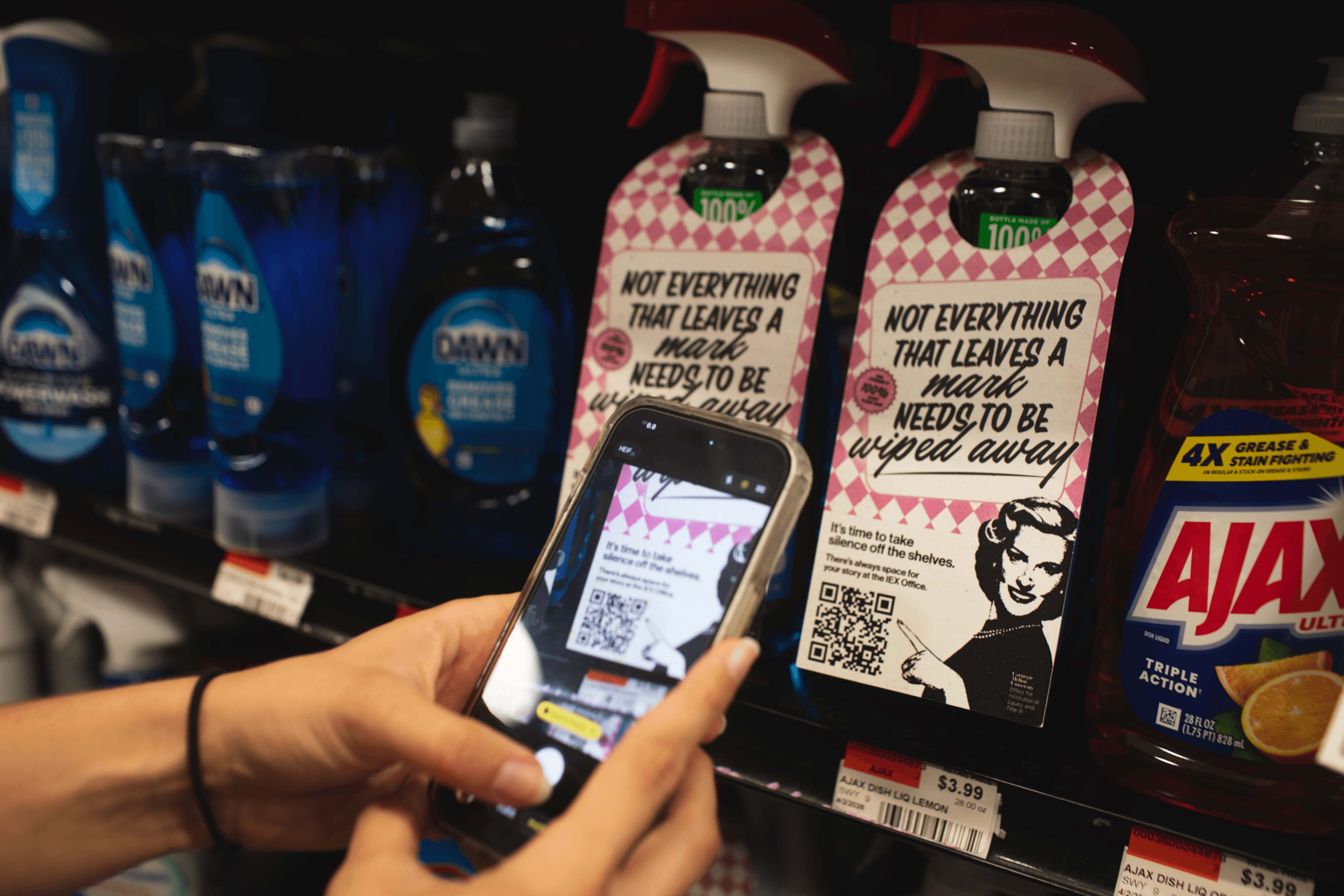


For the coupons, the primary point of action was a QR code printed on the reverse, allowing me to track the number of scans and gauge how many people took the next step.
52 total scans.
47 unique scans.
Final Thoughts
Moving forward, I’ve identified several areas for improvement, the most significant being the need for more distinct and meaningful methods of measuring engagement. Rather than relying on the same QR code, I would track interactions with the bottle neckers and posters/coupons separately to better understand the effectiveness of each intervention. More importantly, how can I measure engagement in ways that provide genuinely useful insights for the IEX office? How can I assess impact beyond visibility alone? And what is the most frictionless way to translate awareness into meaningful engagement with IEX?
I’d also like to test how audiences interpret the campaign’s satire, identifying where humor sparks recognition and where it risks being misunderstood or perceived as insensitive. Does humor make sensitive conversations more approachable, or could alternative approaches encourage deeper reflection and connection? Understanding this balance would help refine the campaign’s tone and ensure that its messaging resonates with audiences without undermining the sensitivity of the subject.
